September 17, 2026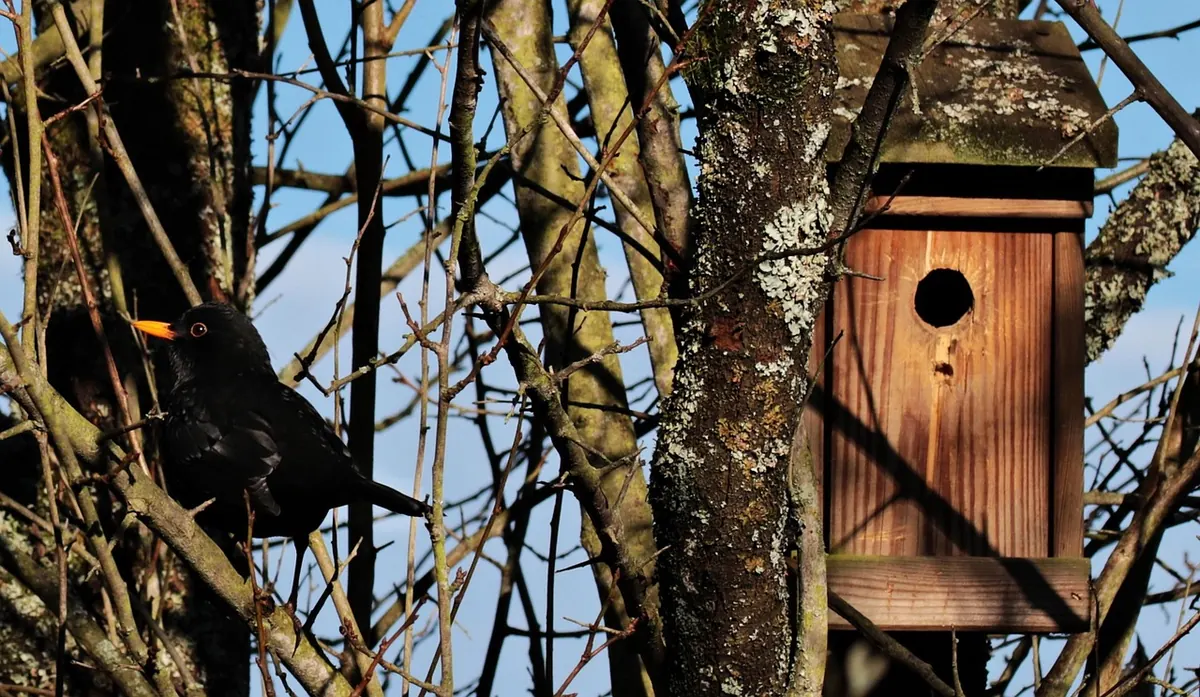
Drill a 32 mm hole into a box built for blue tits and you have not made a blue tit box. You have made a house sparrow box with a blue tit's measurements. The entrance is the one dimension that decides everything: who can squeeze in, who gets evicted, and how well the chicks inside are sheltered from weather and predators. Depth, floor area and mounting height then fine-tune the job. Here is how the regular British hole-nesters compare.
Why the hole matters most
A nest box hole does three jobs at once. It lets the right bird in, it keeps larger birds and predators out, and it limits how much rain and cold air reaches the nest. The tolerances are tight. Three millimetres can be the difference between a blue tit box and a great tit box, and a hole 10 mm too generous will hand your box to starlings or sparrows within a season.
Two design details matter as much as the diameter. The thickness of the front panel — around 15–18 mm for most softwood boxes — gives the hole a tunnel effect that makes life harder for predators reaching in. And a hole set well above the floor keeps chicks out of sight and out of reach.
The hole sizes, bird by bird
- 25 mm — blue tit, coal tit, marsh tit, willow tit
- 28 mm — great tit, tree sparrow, pied flycatcher
- 32 mm — house sparrow, nuthatch, redstart; also accepted by tree sparrows, but it lets house sparrows in
- 45 mm — starling; great spotted woodpeckers will use 45 mm and larger, though they often enlarge the hole themselves
- Open front, no hole — robin, wren, spotted flycatcher, and larger open boxes for kestrels and tawny owls
Small holes: 25 mm and 28 mm
Blue tit box
A 25 mm hole is the classic blue tit entrance and is generally too tight for a great tit, although a small great tit will occasionally squeeze through. Use a floor around 100 x 100 mm, an internal height of roughly 200–250 mm, and set the hole about 120–150 mm above the floor. Mount it 2–4 m up on a wall, shed or tree trunk.
Great tit box
Go to 28 mm and enlarge the floor to about 120 x 120 mm. Great tits are early prospectors — you will often see them inspecting boxes in January and February — so hang boxes by late winter at the latest.
The same 28 mm hole suits tree sparrows and pied flycatchers. If house sparrows are regular visitors to your garden, sticking with 28 mm is the simplest way to give tree sparrows a chance, since the larger bird struggles to get through.
Medium holes: 32 mm
This is house sparrow territory, and house sparrows are not shy about claiming it. They nest in loose colonies, so a row of boxes under the eaves at 2–4 m is often more successful than a single box in the open. Expect them to start early and to raise two or three broods.
Nuthatches also take 32 mm, sometimes up to 35 mm. They need a bigger box than a tit: a floor of about 150 x 150 mm, mounted 2–4 m up against a mature trunk. Nuthatches plaster mud around the entrance, which is a useful clue that your box has been found. Redstarts, less common in gardens and more a woodland-edge bird, use the same size, mounted lower at around 1.5–3 m.
Large holes: 45 mm and above
Starlings need a 45 mm entrance, a floor of at least 150 x 150 mm and a box around 300 mm tall. Site them 3–5 m up on a wall or under the eaves, where they will readily nest in small groups. Starlings begin nesting remarkably early, so a box put up in autumn is far more likely to be used the following spring than one hung in April.
Great spotted woodpeckers will investigate a 45 mm box but frequently chisel the hole wider. If woodpeckers visit your garden, fit a metal plate around the entrance of every other box — they are among the most efficient nest predators around, and a plate costs little.
Depth, floor space and mounting height
Once the hole is right, these are the measurements that decide whether the nest succeeds:
- Depth below the hole: at least 120 mm for tits, 150 mm or more for sparrows and starlings. A dark, deep box deters predators and hides the chicks.
- Floor area: 100 x 100 mm for blue and coal tits, 120 x 120 mm for great tits, 130–150 mm for house sparrows, 150 x 150 mm for starlings and nuthatches.
- Mounting height: 2–4 m for tits and sparrows, 3–5 m for starlings, 2–4 m for nuthatches.
- Direction: face the box between north and east where you can, and tilt it very slightly forward. Avoid a south-west aspect, which takes the brunt of the prevailing wind and rain.
- Spacing: keep boxes of the same size at least 10 m apart if you want separate pairs; sparrows and starlings are happy closer together.
- No perch: a protruding perch below the hole gives predators a place to sit and stare. Leave it off.
Open-fronted boxes: robins, wrens and flycatchers
Not every garden bird wants a hole. Robins, wrens, spotted flycatchers and pied wagtails use open-fronted boxes with a low front lip instead of an entrance. A robin box wants roughly a 150 x 150 mm floor with a 60–75 mm front panel; a wren box can be smaller at around 120 x 120 mm. The key is concealment: tuck them into ivy, a hedge or a sheltered wall between 1.5 and 2.5 m up, angled away from the worst of the weather. Wrens will also use them as winter roost sites.
Fitting the box: a short checklist
Use untreated timber around 15–18 mm thick, with drainage holes in the base and a sloping roof that overhangs the front. Do not paint or treat the inside, and if you treat the outside, use a water-based product and let it dry thoroughly before hanging.
Clean the box out once a year, in September or October, using hot water and a stiff brush — no chemicals. All wild birds' nests are protected while in use in the UK, so leave the box completely alone between March and August, even if it looks abandoned. If you are unsure whether a nest is still active, wait.
Finally, put boxes up earlier than you think you need to. Birds prospect for nesting sites through the winter, and a box hung in mild January weather will always outperform one hammered to a tree in the first week of spring.
Photo: NoName_13 / Pixabay