September 27, 2026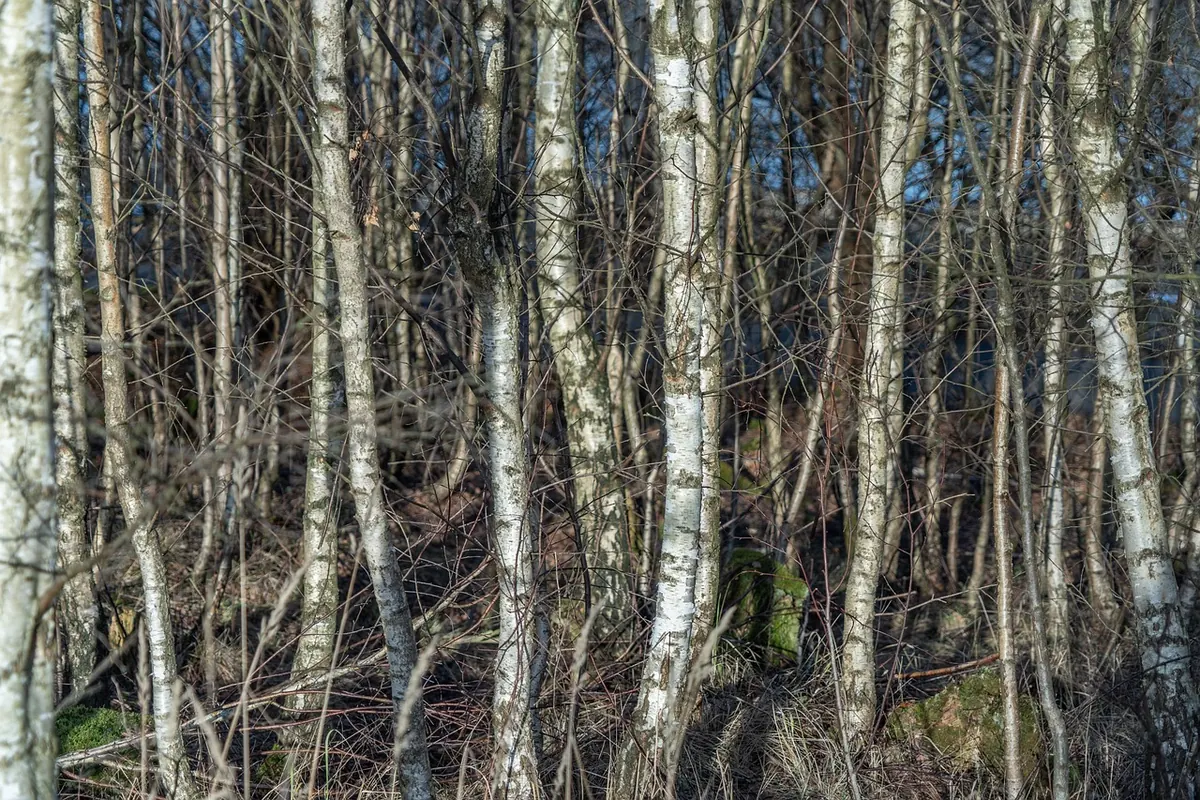
Winter is the honest season for tree spotting. The leaves have gone, the undergrowth has collapsed, and what is left is the structure: the shape of the crown, the texture of the bark, and the buds already set for spring. It is a slower, more tactile kind of identification than a summer walk, and once your eye is in, a bare lane becomes far more interesting than it was in July.
Bark alone will not always settle the argument. The same species can look smooth as a young tree and deeply fissured as an old one, and damp weather, moss and lichen change everything. So treat bark as one clue among three: bark, buds and the overall shape of the tree. When two of the three agree, you can usually be confident.
Look at the whole tree first
Before you get close, walk back twenty paces and look at the silhouette against the sky. Winter light is low and direct, which makes twig density and branch angle easy to read.
An oak holds heavy, crooked limbs and a broad, often stag-headed crown in old age. An ash looks paler and lighter, with branches sweeping upwards and a habit of forking high into what people often describe as a bundle of sticks. A birch is slender and airy, its fine twigs giving the whole crown a soft, purplish haze. A sycamore is dense and rounded with thick, blunt twigs, while an alder often stands dark and cone-shaped near water. Limes are twiggy and congested, frequently sprouting bushy growth from the trunk.
The bark textures worth learning
Almost every tree you meet in Britain will fall into one of a handful of textures. Learn these and you will be reading trunks rather than guessing at them.
- Smooth grey: beech, hornbeam, lime, young ash and young oak. Beech is the classic, often with faint horizontal banding that looks like stretched muscle.
- Fissured and ridged: mature oak, sweet chestnut, old ash, willow and alder. Sweet chestnut is the most dramatic, its ridges twisting in spirals up the trunk.
- Plated and flaking: sycamore, which sheds grey-brown plates to reveal paler patches beneath, and Scots pine, whose upper trunk turns orange-red and scaly.
- Peeling and papery: the birches, with thin strips curling away and dark diamond-shaped lenticels dotted through the white.
- Banded with lenticels: wild cherry, whose glossy reddish-brown bark is scored with horizontal lines and, on older trees, peels in neat horizontal strips.
- Fluted: hornbeam and yew, where vertical ridges ripple and swirl as though the trunk were twisted.
Bear in mind that moss, lichen and algae will tint a trunk green, grey or yellow, and that a wet tree always looks darker than a dry one. Learn to look through the surface to the structure underneath.
Buds: the detail that tells the truth
Opposite or alternate?
Run a thumb and forefinger along a twig and feel where the buds sit. If they come in facing pairs, the arrangement is opposite. If they alternate along the stem, it is alternate. Only a few common British trees have opposite buds — ash, sycamore and field maple among the natives, plus the planted horse chestnut and lime in places, depending on how you count — so this single check rules out a great many possibilities. Oak, beech, birch, willow, alder and hazel all alternate.
Shapes to memorise
- Ash: sooty black, velvety and blunt, in opposite pairs. Nothing else looks quite like it.
- Beech: long, slim and sharply pointed, coppery-brown, held at about 45 degrees out from the twig.
- Horse chestnut: large, glossy and sticky, with a horseshoe-shaped leaf scar beneath.
- Oak: a cluster of small oval brown buds bunched at the twig tip, like a small fist.
- Alder: purple-brown buds on short stalks, often with old cone-like catkins still hanging nearby.
- Hazel: rounded green-brown buds, with yellow lamb's tail catkins from midwinter onwards.
Tricky pairs and how to separate them
Beech or hornbeam
Both are smooth and grey, and both hold onto dead leaves through winter. Look at the trunk: hornbeam is fluted and sinewy, beech smoother and more even. The buds differ too — beech buds are long spindles, hornbeam buds shorter and striped. On the ground, beech husks are prickly and four-lobed, while hornbeam seeds hang in papery, three-lobed wings.
The two oaks
Pedunculate and sessile oak are notoriously hard to tell apart by bark. Check the ground beneath instead: pedunculate oak acorns hang on stalks, sessile oak acorns sit directly on the twig. Sessile oak also tends to favour drier, upland ground, and its leaves have stalks rather than lobes running to the base.
The birches
Silver birch has whiter, more papery bark with prominent diamond lenticels and drooping twigs. Downy birch is greyer, peels less dramatically, and grows more often on wet, peaty ground. If the tree is standing in a bog with a slightly scruffy look about it, downy is the better bet.
A field routine that works
- Stand back and note the shape of the tree and where it is growing.
- Look down: leaf litter, husks, cones, keys and seed cases often name the tree for you.
- Check a twig for opposite or alternate buds.
- Study the buds closely with a hand lens. A cheap ten-times lens is enough.
- Then read the bark: texture, colour, lenticels, and whether plates peel.
- Look for anything persistent — beech leaves, alder cones, ash keys, old seed heads.
- Confirm with a field guide, and photograph the tree, the twig and the trunk for reference.
Work from fallen twigs rather than breaking anything from a living tree, and never strip bark. If you are ever tempted to forage, identify with certainty first and leave anything doubtful alone.
Keep it simple, keep it slow
You do not need to name everything on the first walk. Choose half a dozen trees you pass regularly — one oak, one beech, one ash, one birch, one sycamore, one cherry — and visit them once a month through the year. Notice how the buds swell in February, how cherry bark reddens in the rain, how the moss creeps up the north side of an alder.
Carry a small notebook and a hand lens, and jot the date beside each observation. Within a winter or two you will find that the bare months stop being a gap in the year. They become the season when you finally learn the trees properly.
Photo: ubcmio / Pixabay